Posted on

It’s an Industrial Revolution – in OO!

Revolution Trains is offering the Hunslet 0-6-0 diesel hydraulic (DH) shunter in OO gauge.

Original NCB design

CAD is virtually complete and incorporates numerous options to allow for both 50T and 55T locomotives to be depicted with variations including engine room air breathers, handrails, footstep equipment boxes and sandbox fillers. The ‘flameproof’ versions used in refineries can also be produced.

Hunslet line-up at Workington steel works. Photo: John Carter.

Between 1965 and 1989 well over 50 0-6-0DH shunters were built by Hunslet for the British market. More were also built to a variety of gauges for users abroad in south America, Africa, Europe and the Indian subcontinent.

The Hunslet 0-6-0DHs were surprisingly powerful for their size, and their short wheelbase enabled them to operate in locations where other locomotives may struggle.

Model features

All models feature a heavy die-cast chassis block for reliable running, and a high reduction gear train to ensure smooth and realistic slow speed running.

‘Flameproof’ refinery design with single enclosed headlight

The locomotives will all have working head and tail lights and an illuminated cab interior, and where prototypically correct a flashing roof beacon.

A 21-pin MTC decoder socket is included with factory-fitted speaker, so upgrading to sound is simple. The decoder is accessed by simply unscrewing the body and lifting it clear of the chassis.

DCC sound models will also incorporate a stay-alive power pack, and this will be designed as a simple plug-and-play uprgrade for DCC Silent users.

The line up

Initially Revolution is offering four versions, with prototypically accurate detail variations intended to cover a wide variety of eras and locations.

HE6614 – NCB green

This locomotive was built in 1965. The National Coal Board was the largest user of the type, and this locomotive was given the internal number 503 and assigned to the North Eastern Area.

Locos in this version of the NCB livery saw service at collieries across the north and Midlands, often working alongside earlier steam locomotives.

Spotting points include the small sandboxes, dome breather on the right side of the long bonnet, as well as early pattern handrails. This loco has no roof beacon.

HE7017 – HNRC

Built in 1971 and originally used at Whitehaven harbour the locomotive was later acquired by Harry Needle Railroad Company, given the number 29 and used in a variety of locations for spot hire work, and it is offered in this later condition.

As a shunter-for-hire it’s been used at locations including Flixborough Wharf and Long Marston. This locomotive features more substantial handrails, dome breather mounted on the bonnet top and a flashing beacon, along with an equipment box on the right side.

Photo of 7017 at Long Marston courtesy Martyn Sanders.

HE7543 British Steel

This locomotive has seen widespread use – first at British Steel Workington, numbered 403, then it moved on to Shap quarry where it currently resides, though no longer in regular use.

The spotting points for this version are the oval buffers with strengthened shanks and conical breather.

Photo of Hunslet line up courtesy John Carter.

7543 at Workington exchange sidings with 66752. Photo courtesy Dave McAlone.

HE8999 Esso

This locotive is one of the last-built of this design, entering service in 1981 and operating variously at Fawley and Grangemouth before being sold. It is now in residence at the Chasewater railway at Brownhills in Staffordshire.

This locomotive is to the ‘flameproof’ design for refineries and features enclosed side cabinet and fire suppresant equipment. It has an extended exhaust (to be added to the CAD) and no roof beacon.

The CAD for this models is complete, barring some very minor adjustments, and we are hoping to receive first samples during the summer.

Industrial inspirations

The first four locomotives offered by Revolution have been selected to showcase a variety of liveries, details and uses but they can only scratch the surface of the wide range of locations served and liveries worn by these popular and long-lived locomotives.

From left: 8979 ‘Black Agnes’ at Dunbar. Photo davyc2008 – 7017 at Whitehaven 1982 – 6663 & 7018 Bersham 1986.

If you are interested in seeing more we heartily recommend the Flickr gallery of photographer Gordon Edgar. Here are a selection of his images.

You can find his full image directory here:

.

Posted on

Get down to steel town!

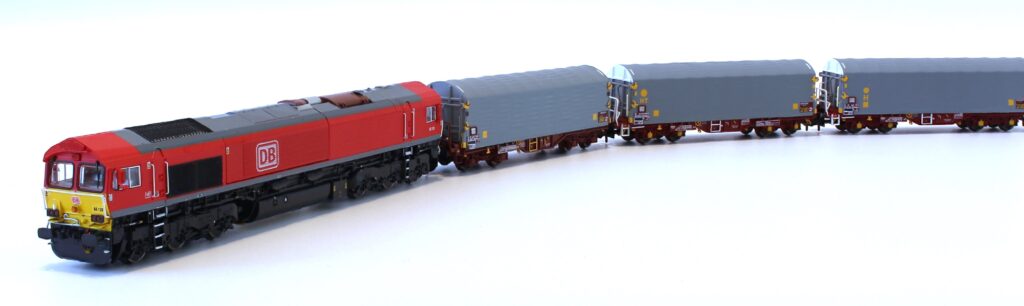
Revolution Trains has received decorated samples of its upcoming IHA (UIC code: Sfhimms) canvas covered steel carriers in OO and N.

These models are now being assessed and checked before full production is started. We expect to be closing the order book for these models in the next 4-6 weeks, though as ever they will be available from retailers after production.

The models being offered are the same in OO and N.

In OO the models are, clockwise from top right: Original livery RT-OO-IHA-401; HT-spot marked livery RT-OO-IHA-402, H-spot livery OO-IHA-403 and current Ermewa branded livery RT-OO-IHA-404. For each version, four numbersets are available with the suffix A, B, C and D on the product code.

The same variants are available in N, with the same variety, meaning up to sixteen different running numbers are available, with prototypical variations in labelling and data placards.

The models feature all our usual refinements including separately fitted locking hooks, underfloor brake details and photo-etched end platforms. The OO versions also have bogies designed to accept P4 or EM wheelsets, and the brake blocks can me moved outward to accommodate this.

These wagons are used across England and Wales to transport steel coil from Margam for domestic customers and for export. They are also used for imported steel from Humberside and Lincolnshire to the midlands.

In the past traction has included Classes 47, 56, and 66 among others.

Photo credits, clockwise from top left: Roger Cutts, Hugh Llewellyn/Creative Commons, Foulger Rail Photos/Creative Commons, Arran Aird, Paul van Duin, Foulger Rail Photos/Creative Commons, David Smith, GarstangpostT21.

The wagons are the ideal accompaniment to our upcoming Tata Steel CBD-90 Clayton battery hybrid shunter in OO and our Class 66 locomotives in N.

The pre-order prices are OO £39.95 (MSRP £48.95) and N £36.95 (MSRP £47.95.) Pre order your models here.

Posted on

ROG invites Revolution to see the 93…

Revolution Trains has been able to go and visit the first of the new Class 93s – 93001 – at the depot being used by its owners Rail Operations Group as a base for the approvals procedures now needed before the locomotives can enter service.

The Class 93s are tri-modes – able to draw power from 25kV OHLE, from an onboard battery pack or from a 1200hp Caterpillar diesel.  They are designed as a flexible go-anywhere option (one reason why, unlike early renders, the finished loco has a yellow front panel) and this week ROG have been displaying the new arrival to a succession of potential users.

Our visit is going to be the first of several as we adapt the CADs we already have (derived from information sent by Stadler) to match the locomotive as it is built and incorporating alterations made during that process. 

Draft CAD image. Even a cursory glance will reveal numerous variations between this and the as-built locomotive

For example, some parts of the underframe have been altered or reconfigured and initially the design followed European practice in not having cab door windows; these have since been added and will be to our CAD of course.

For ROG the next stage is a combination of testing both in Britain and abroad and there may well be further changes to ensure the locomotive conforms to any further gauging, safety, operator or staff requirements and these will be incorporated. 

While we are keen to develop this model as quickly as possible we will not begin the expensive tooling until the locomotive is in its ‘service’ condition; furthermore the licence we have with Stadler and ROG stipulates that the models must not be released before the locomotives begin to enter service.

We’d like to thank the team at ROG for welcoming us yesterday, and for a rather nice guidebook, and look forward to providing further updates as the project develops. In the next week or so look out for a short video giving more detailed information about this trip and the next stage of the locomotive’s development and introduction.

Posted on

Battery diesel hits the road…

The Clayton CBD-80 and CBD-90 models in development by Revolution Trains recently featured on an episode of the TV show ‘Train Truckers’ on the Yesterday Channel. Yesterday is one of the family of channels broadcast by UKTV, which is part of the BBC.

In the programme specialist haulage form Allelys are tasked with transporting one of the Sellafield CBD-80 variants from Clayton’s plant in Burton to the Chasewater Railway for testing.

Previously Allelys had also moved a CBD-90 locomotive on behalf of steelmaker Tata, who operate a fleet.

Photo: Allelys.
Photo: Allelys.

The programme also features the similar, but heavier, CBD-90 locomotives being built by Beacon Rail and now in service with GBRf at Whitemoor depot. These featured in our own video to introduce the models.

The models are now in tooling and EP1 samples are expected in the next 6-8 weeks, following approval of the CAD diagrams some weeks ago.

Beacon CBD-90 with single light
Beacon CBD-90 with BMAC lights
Tata Steel CBD-90

Train Truckers S2 EP2 can be viewed here

The Revolution Trains introduction video can be seen here

These models can be pre-ordered exclusvely from Rails of Sheffield here

Posted on

ROG 93 revealed…

The first locomotive of the new Class 93 tri-mode fleet being built for Rail Operations Group by Stadler has not been completed yet, and their entry into service is probably a year away, but despite this our designers have been making progress on CAD of the model in 00, and we thought modellers may be interested in seeing progress.

The CAD has been produced from drawings and 3D files kindly provided by Stadler’s engineers to assist us in production of the model.

As can be seen there is plenty of detail, although the pantograph has not yet been added to the roof. On the finished models it will be positioned at the near end in the image above, and will be controllable under DCC.

The prototypes are designed to be a medium power ‘go anywhere’ locomotive designed to fulfil Rail Operations Group’s core business of moving new (or in service) trains around the network as well as powering new high-speed parcels and city-to-city light intermodal traffic.

The design of the cab draws on Stadler’s house style and is clearly influenced by the company’s very successful Euro Dual family of locomotives. Although Rail Operations Group released an artist’s representation of the finished locomotives when they announced their plans, there may yet be some adjustments to the final livery designs.

The underframe will feature a host of separately fitted details; much of the underframe shares a commonality with the Stadler-built Class 88s in operation with DRS, part of Nuclear Transportation Service, which is a subsidiary of the Nuclear Decommissioning Authority.

The chassis design is still subject to possible change; this cutaway view shows the current arrangement with Plux-22 DCC interface below a panel at the ‘diesel’ end of the locomotive, and space left at the far end for the pantograph operating servo, as well as the fully detailed cab interiors.

The models will be highly specified with a full suite of working lights, DC silent and DCC Sound options and along with a working pantograph. The image above shows the cooler group with one of the photo-etched grilles removed to show the fan detail.

Other details include numerous separate parts on the bogies and representation of the Dellner coupler carried by the locomotives to enable them to couple to many of the numerous classes of unit they will have to move, as well as modern coaching stock such as the Mk5As in service with TPE.

While this represents an excellent start there remains plenty to do to complete the design work, and once the first of the prototype locomotives are nearing completion Revolution expects to visit Stadler’s manufacturing plant in Valencia to photograph and measure the fine details, and check for changes made to the design plans during construction. Tooling will not begin until we are sure testing is completed and no visible alterations are required.

We won’t know the final cost of the model until the CAD work is complete and all specifications fully locked in therefore we do not expect to open the order book for these models until early 2023, however we will keep our supporters updated on this exciting project as we pass through each stage of development.

Posted on

Revolution goes tri-mode for Class 93 locos with ROG!

Revolution Trains is to produce the all-new Class 93 tri-mode locomotive being built for Rail Operations Group by Stadler as its first powered model in 00/4mm scale.

Class 93 image courtesy ROG/Stadler

Rail Operations Group has ordered ten of the new Class 93 locomotives, with options on a further 20, and the first is to be delivered in early 2023.

The Class 93 is designed to operate on 25kv overhead power supply, with an inboard diesel engine, or using heavy duty batteries; allowing it to be almost silent while in stations or other built up areas while optmizing efficiency across the network and maximizing low carbon benefits. The Class 93 will be able to run at speeds of up to 110mph and the diesel power unit is specified to be powerful enough for prolonged mainline running, not just ‘last mile’ operation.

Revolution Trains is delighted to have been chosen by ROG and Stadler to produce the Class 93 tri-mode locomotive, which is arguably the most exciting and innovative development on the real railway for many years.

Neil Bennett, Executive Chairman of Rail Operations Group, said: “Along with our well-established rolling-stock movement business, we have very exciting plans for the Class 93 including low-carbon logistics services operating at speeds of up to 110mph.  I am delighted to be working with Revolution Trains on reproducing the locomotive in model form.”

This will be Revolution’s first powered model aimed at 00 gauge/4mm scale modellers, but Revolution has already delivered, or is developing, six 00 wagons: TEA tankers, MMA/JNA ‘Ealnos’ box wagons, IZA Cargowaggon twins (a Kernow exclusive), IWA ‘Sfins2’ vans, IWA ‘Rfnoos’ timber carriers and FWA ‘Ecofret’ container flats.

The model will be to 4mm:1ft scale, 1:76.2 with RP25-110 wheels with space for EM/P4 fitting. They will feature our usual high levels of detailing including photo-etched and separate parts where appropriate, prototypical lighting arrangements, 21-pin DCC socket, and heavy metal chassis with full provision for DCC Sound. DCC Sound-fitted models will also be available.

We will offer multiple numbers, factory-fitted buffer-beam details at one end (though a spare NEM coupler will also be included for customers who wish to couple the loco at both ends) and we will investigate the provision of a DCC operated pantograph mechanism.

The full specicifation is subject to revision during the design phase, but will be confirmed by the time we open the order book.

Rail Operations Group’s core business is moving rolling stock around the network.

Rail Operations Group has exciting plans for the Class 93, and while initially they are likely to be used mainly to service ROG’s existing and well-established rolling stock movement business, the company also sees the locomotives being used as part of its proposed ‘Orion’ high speed centre-to-centre low carbon logistics trains as well as 110mph intermodal services. For more information see here.

ROG is planning to begin trials of its first converted Class 319 units in April 2021. The images below show the first unit being unveiled last month.

The Class 93 models will be offered in ROG’s stylish green and black launch livery, and it is understood that they are to be named after Roman Gods.

The terms of the licence – which covers both 00 and N gauge models – mean that ROG and Stadler will work closely with Revolution, sharing important technical specifications, 3D data and design drawings, to ensure the models are as accurate as possible and that any changes made during construction are incorporated.

Class 93 Initial Specification

  • Heavy diecast chassis with smooth electric motor and flywheels and provision for DCC and Sound
  • 4mm-ft/1:76.2 scale 00 (16.5mm) gauge, with provision for simple conversion to EM/P4
  • Separately applied etched metal or fine plastic details
  • NEM coupler sockets with fully detailed, factory-fitted bufferbeam at one end (second coupler in accessory pack)
  • DCC provision: 21 pin decoder socket
  • Prototypical lighting arrangements, switchable for DC users where necessary
  • Twin speakers on sound-fitted models
  • RP25 (110) wheels with provision for simple conversion to EM/P4
  • We will investigate options for a DCC operated pantograph mechanism, though the pantograph itself will be cosmetic

It is intended that the models will be delivered as soon as possbile after the prototypes enter service.