

Revolution Trains is closing the pre-order book on its upcoming PTA box wagons and JSA steel carriers at the end of November, having received decorated samples recently.


These wagons were built in the early 1970s to carry iron ore for British Steel, but have also seen use for stone, ballast and sand. In the 1990s some were also converted into covered steel carriers, as detailed below.
Iron Ore
The wagons were built by Redpath Dorman Long to carry iron ore for British Steel. Iron ore is heavy, and the wagons needed to be robust. They were heavily ribbed and featured ESC axle-motion bogies with hefty cast frames for strength.
In British Steel use they transported ore to blast furnaces at Ravenscraig in Lanarkshire, Redcar on Teesside and Port Talbot in South Wales. The wagons allowed for significantly longer and heavier trains than previously used, and were operated by triple-headed Class 37s in the 1970s and then by pairs of Class 56s into the 1990s, when single Class 60s took over. Class 59s were also trialled on the trains to Port Talbot in South Wales and from 1998 Class 66s became the primary traction.


Left: 56001 + 56041 at Rumney in 1988. Mick Page. Right: 60093 at Cardiff Central inn 1994; Ryan Taylor LRPS/Creative Commons.

The wagons were designed to ‘tipple’; that is, they could be rotated about their longitudinal axis without being uncoupled from each other in a specialist frame for speed of unloading. To do this each wagon had a rotating coupler at one end; this end was painted orange for the benefit of the operating crews.
The wagons used in the north east were grey and orange; those used in south Wales were blue and were labelled British Steel with the arrow logo.


The image shows both variants; the blue is fractionally too light and will be darkened for production. This image also shows that among the wagons there were ‘outers’ – with buffers, and bufferbeam strengthening fillets above the bogies and standard drawgear to enable them to be coupled to locomotives, and inners which had fixed rotating couplers only.
Revolution is offering the models in packs of five to allow prototypical rakes to be assembled.


British Steel Grey:
RT-PTA-BSRV-521A (2 x outers, 3 x inners) – BSRV 26794, 26787, 26680, 26681, 26734
RT-PTA-BSRV-522B (5 x inners) – BSRV 26713, 26760, 26762, 26691, 26765
British Steel Blue:
RT-PTA-BSSW-531A (2 x outers, 3 x inners) –BSSW 26666, 26674, 26635, 26566, 26617
RT-PTA-BSSW-532B (5 x inners) – BSSW 26664, 26590, 26610, 26662, 26572

Stone and sand
In the 1980s, with the contraction of the steel industry and closure of some blast furnaces, iron ore traffic declined. At the same time construction was booming, and a high demand for box wagons in this sector led to many PTAs being acquired by Foster Yeoman and ARC Southern for use in transporting stone from the giant Mendip quarries in Somerset to London and around the south east.


Top: 59104, Frome in 1991; 59002, Westbury 1991. Both images: Richard Szwejkowski/Creative Commons. Avon Valley, 1993. Graham Rose. Bottom: 59001, Basingstoke, 1996. Paul Smith/Creative Commons.
Foster Yeoman and ARC locked the rotating couplers as they were not required and repainted the wagons into their own liveries. The wagons were also recoded to JTA (outers) and JUA (inners) under TOPS. Initially they operated as separate fleets, but in the mid-1990s the two companies decided to combine their rail operations under the Mendip Rail brand, and the types were often seen in mixed trains.


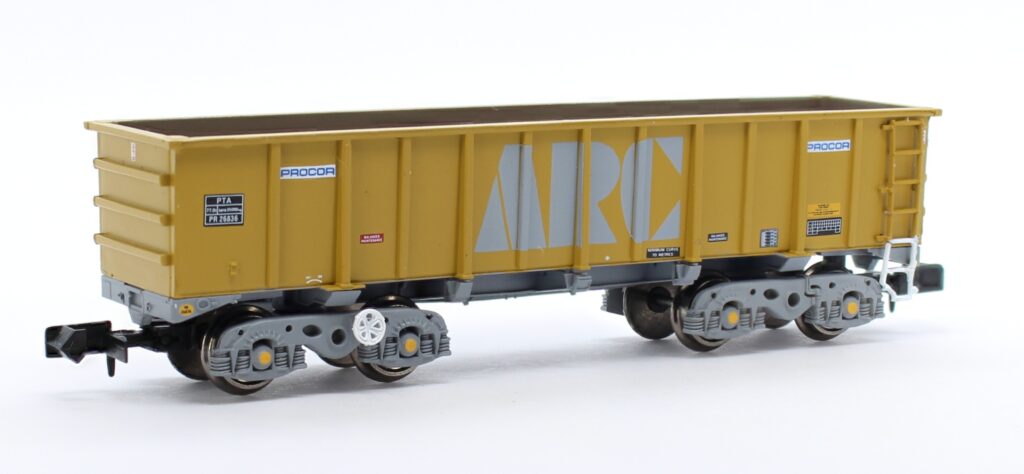

There are some improvements to be made to these wagons; the ARC lettering should be slightly darker (to match the Revolution Class 59 locomotives) and the blue stripe on the Yeoman model should be continuous across the ribs.
Again, Revolution is offering the models in packs of five to allow prototypical rakes to be assembled.


Foster Yeoman:
RT-PTA-FY-501A (2 x outers, 3 x inners) – PR 26561, 26552, 26496, 26509, 26457
RT-PTA-FY-502B (5 x inners) – PR 26489, 26534, 26516, 26473, 26540
ARC:
RT-PTA-AR-511A (2 x outers, 3 x inners) – PR 26801, 26803, 26836, 26840, 26844
RT-PTA-AR-512B (5 x inners) – PR 26805, 26814, 26831, 26832, 26849
From the mid 1990s some wagons were also used for ballast movements and for scrap between the midlands and south Wales.
In the early 2000s a batch was sold to wagon leasing company VTG, painted into a medium battleship grey and repurposed for use on sand traffic around the south east. See top map for route informationon the sand flows.


L-R 66120 at Merstham, 2015. Steve Knight. 66094 at Clapham Junction, 2006. Matt Taylor/Creative Commons.

These versions are being offered as a single 5-car set with outers and inners.
RT-PTA-VTG-541A (2 x outers, 3 x inners) – VTG 26833, 26563, 26617, 26598, 26601
Pre-order price £174.95 (MSRP after production £199.95.)
JSA steel coil carriers
In the mid 1990s British Steel converted a batch of tipplers into steel coil carriers with the addition of a contoured floor and three sliding telescopic covers. In 2007 a further batch was converted for VTG. The original conversions were painted pale blue; the covers on the later variants were left unpainted alumimium.


Prototype images: Top row: 60073 at Besford, 1998; 60017 at Hereford, 1997; 47739 at Norton Junction, 2014 – all Dave Gomersall. Second row: 66140 at Shrewsbury – Steve Knight.
The JSA steel carriers saw widespread use between steel production plants in south Wales and north east England and steel terminals in the south, the midlands and the north west. They were also used intermittently on imported steel.
In use they were usually mixed with other covered steel carriers including BRA/BYA ‘nissen hut’ and IHA canvas covered wagons.

The JSA steel carriers are being offered in twin packs with a total of eight running numbers available:
British Steel:
RT-JSA-BSSP-201A (twin pack) – BSSP4027 & BSSP4037
RT-JSA-BSSP-202B (twin pack) – BSSP4074 & BSSP4096
VTG:
RT-JSA-VTG-213A (twin pack) – VTG4022 & VTG4064
RT-JSA-VTG-214B (twin pack) – VTG4049 & VTG4076


